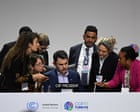
COP31 Climate Talks Collapse Over Fossil Fuel Omission
The COP31 summit in Antalya, Turkey, became the longest-running UN climate talks in history before breaking down after the EU, UK, and developing nations rejected a final deal that failed to mention fossil fuels. Ireland's environment minister stated the proposed text 'failed.
The COP31 climate summit in Antalya, Turkey, collapsed after the EU, UK, and developing nations rejected a final deal that omitted any mention of fossil fuels, making it the longest-running UN climate talks in history. The failure exposed deep geopolitical rifts and raised questions about the viability of the COP process itself, as countries could not even reaffirm previous commitments like the COP28 pledge to transition away from fossil fuels.
-
Record-breaking duration and final rejection
The talks, scheduled to end on Friday, dragged into Sunday afternoon, making them the longest in UN climate summit history. The EU's representative, Ireland's environment minister Darragh O'Brien, stated the proposed 'Antalya pact' 'failed to meet the moment' and did not even mention fossil fuels, leading to its rejection. The co-president, Australia's climate change minister Chris Bowen, acknowledged that the red lines the presidencies tried to negotiate were 'unbridgeable'. [3] [1] [2]
-
Geopolitical divisions and accusations
The negotiations were marked by pointed remarks: EU representative Darragh O'Brien said the talks had been 'hijacked by some oil states', while Russian delegate Sergei Kononuchenko accused the EU of providing climate finance only as loans, calling it 'an old colonial distribution of labour under a new banner'. The UN secretary general António Guterres expressed deep disappointment, and former US Vice President Al Gore called it 'outrageous that a handful of petro-states have veto power over any mention of fossil fuels'. [1] [2]
-
Controversial provisions on carbon capture and storage (CCS)
The rejected Antalya pact included provisions on carbon capture and storage (CCS) technology, which some critics said perpetuates fossil fuels. The EU's O'Brien stated the bloc would not accept a decision 'that greenwashes fossil fuels'. Saudi Arabia defended the inclusion of CCS in the text, while Mohamed Adow of Power Shift Africa called it 'the worst Cop ever' and accused Europe of hypocrisy for demanding fossil fuel roadmaps from others while expanding fossil fuels themselves. [3] [2]
-
Failure to reaffirm previous commitments and financial pledges
The talks exposed that consensus does not last forever: the same pledge to transition away from fossil fuels had been made just three years ago at COP28 in Dubai. Rich nations also failed to put a figure to additional climate finance for developing countries, despite a prior commitment to triple adaptation finance to $40bn by 2035. The draft agreement acknowledged that global temperatures are expected to exceed the 1.5°C threshold of the Paris Agreement, and suggested carbon dioxide removal (CDR) as a measure, which had not been explicitly mentioned in a COP final agreement before. [2]
-
Mixed reactions from developing nations and partial progress
While the EU, UK, and small island states rejected the deal, some countries like Pakistan and Ghana did not object, with Pakistan stating 'climate action is not a menu from which we can select only what suits us'. Despite the collapse of the central political agreement, 164 other agenda items were negotiated, including agreements on a global carbon credit system and a just transition framework. The UN climate chief Simon Stiell emphasized that 'real progress and concrete results' were achieved on many items, though the overarching outcome fell short. [3] [2]