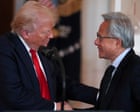
Jensen Huang's Return to Nvidia Sparks Controversy and Pardon Talk
Nvidia CEO Jensen Huang was reinstated after breaking the company's code of conduct over a relationship with an alleged chip smuggler, prompting President Trump to suggest a potential pardon. The BBC notes Huang's unique irreplaceability at Nvidia, while TechCrunch reports.
Nvidia CEO Jensen Huang was reinstated days after being ousted for violating the company's code of conduct over an affair with an alleged chip smuggler. The controversy has drawn in President Trump, who suggested a potential pardon, while Congress and regulators continue to probe whether Nvidia's chips were illegally diverted to China.
-
Huang's affair and alleged chip smuggling
Huang admitted to an affair with Alice Huang, an executive at Singapore-based data center operator Megaspeed, who is accused of being part of a network that funneled Nvidia chips to a company in Shanghai. The Wall Street Journal reported that Alice Huang and her husband, Kang Wei, were involved in the scheme, and that Kang introduced Alice to Jensen Huang, whom he had known for a decade. The U.S. government added Megaspeed and its affiliates to a restricted trade list on Monday, citing national security concerns. [1] [2]
-
Trump's role in Huang's reinstatement
President Trump personally pushed for Huang's return, calling into Nvidia's board meeting to give assurances that his return posed no national security risk. Trump told the New York Post he would be open to pardoning Huang, saying "It's always an option, I guess," but added he didn't think it would be necessary. Vice President JD Vance later said Huang was "under no investigation" and did not need a pardon, based on assurances from Attorney General Todd Blanche. [1] [5]
-
Ongoing congressional and regulatory investigations
Despite Huang's reinstatement, Nvidia faces multiple inquiries: three House committees will privately interview Huang and Nvidia's top lawyer Tim Teter next week, and the Senate Banking Committee will question Huang in a public hearing on December 3. The SEC is reportedly investigating Nvidia's corporate disclosures, and California Attorney General Rob Bonta has opened an investigation tied to chip diversion. Senator Elizabeth Warren demanded the Trump administration explain what "input" was given to support Huang's reinstatement. [2] [5]
-
Nvidia's code of conduct and employee morale
In his first all-hands address since returning, Huang admitted to violating Nvidia's code of conduct but said breaking it doesn't automatically cost anyone their job, stating "Facts, circumstances, a lot of assessments" matter. Ethics expert Matt Plass of LRN warned that the biggest risk is employees becoming ashamed of their workplace, noting that ethics are "incredibly important" to new workers. Huang's return has not yet caused a morale problem, but sidestepping the code could cost Nvidia employees' pride in the company. [3]
-
Economic impact of Huang's brief departure
Huang's brief ouster caused Nvidia's value to sink by $1 trillion before it climbed back, affecting pension funds, investors, and Nvidia employees who hold company stock as part of their pay packages. Nvidia's chips are considered the best for AI, with its Rubin and Vera GPUs selling for tens of thousands of dollars each, and the company's dominance in the AI sector made Huang's return critical to market stability. [1]